Study System That Beats Cramming: Plan, Active Recall, Review
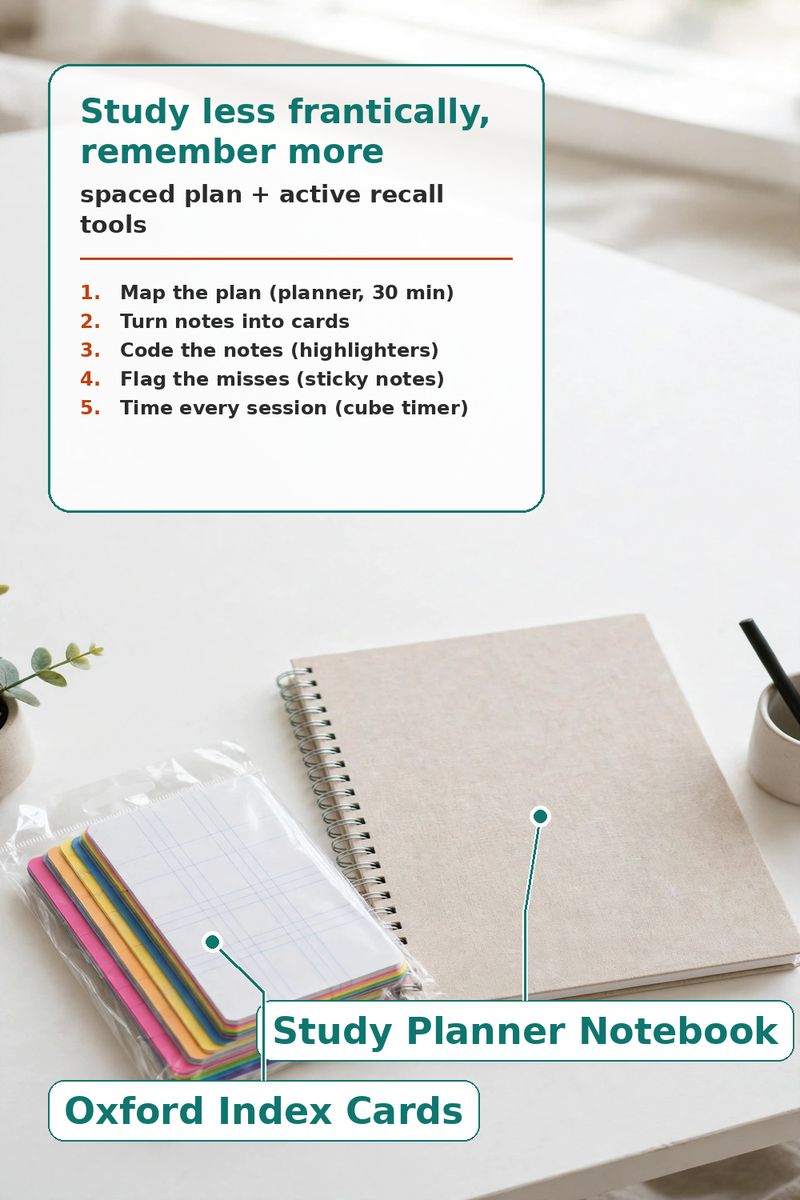
The promise: An exam study system - spaced plan, active recall tools, review days - for students of any age
Cramming feels busy but forgets fast. This exam study system replaces it with five moves that actually stick: a spaced study plan that maps every topic to a day, active recall flash cards that force you to retrieve answers instead of re-reading notes, color-coded highlighting so the important ideas stand out at a glance, sticky notes for the questions you keep missing, and timed focus sessions so study blocks stay short and honest. Review days are built into the plan, not bolted on at the end, so the second and third passes happen before the exam, not the night before. The system works the same whether the exam is a school final, a licensing test, or a certification — the subjects change, but the loop stays plan, recall, review. Start the week with the planner open, end each session by writing the next day's cards, and let the timer keep every block honest.
How this post keeps its promise
- Step 1 — Map the plan (planner, 30 minutes, once): list every exam topic in the planner, then assign each topic to a study day, working backward from the exam date. Leave every third day blank — those are review days, not free days.
- Step 2 — Turn notes into cards (index cards, as you study): after each study session, write 5–10 cards from that session only — question on the front, answer on the back. A card you can answer from memory is done; a card you can't goes in the "again tomorrow" pile.
- Step 3 — Code the notes (highlighters, during review): re-read your notes once with the highlighters — definitions in one color, formulas or dates in a second, likely exam questions in a third. If a page has no highlights, it wasn't worth re-reading.
- Step 4 — Flag the misses (sticky notes, every review day): on review days, work through the card pile first, then re-read only the highlighted pages. Stick a note on anything you still miss — that note is your next session's starting point.
- Step 5 — Time every session (cube timer, every session): flip the cube for a fixed session (25 or 45 minutes), stop when it ends, and take a real break. Three honest sessions beat six distracted hours, and the timer is what makes the count honest.
The loop is plan → recall → review → repeat, and the planner's review days are what keep it from collapsing into last-night cramming.
Products mentioned
- Study Planner For Students, 3 Month Academic Planner, Daily Study Tracker With Spiral Binding, Goal Setting, Homework Organizer, School Planner Notebook
the spaced plan lives here — daily study tracker pages, goal-setting sections and a 3-month span that covers a full exam cycle.
[Affiliate Link Would Go Here] - Oxford Rainbow Ruled Index Cards, 3 X 5 Inches, Assorted Colors, Pack Of 100
the active recall tool — write the question on one side, the answer on the other, and shuffle daily so recall, not recognition, does the work.
[Affiliate Link Would Go Here] - Bic Brite Liner Highlighters, Chisel Point, Assorted Colors, 5 Count
color-coding for notes — one color for definitions, one for formulas or dates, one for "will definitely be on the test."
[Affiliate Link Would Go Here] - Post-it Super Sticky Die-cut Notes 150 X Assorted - 3" X 3" - Daisy - Assorted - Self-adhesive - 2 / Pack
the review-day flag — stick one on every page or card you got wrong, so the next review session starts exactly where you are weakest.
[Affiliate Link Would Go Here] - Productivity Cube Timer Flipping Led Display 4 Preset Time Dual Modes Countdown Cooking Study Mini Timer
flip the cube to start a timed focus session — no phone, no app, no "just checking one thing" drift.
[Affiliate Link Would Go Here]
Demo site: product links are placeholders, and prices are intentionally omitted.